Men on Show · Episode 41
Why Men Are Choosing Running Over Therapy with Richard Loftus
- 12 February 2025 .
- 47 min .
- Hosted by Andrew Pain .
Richard Loftus is the founder of Well Run Brum, the wellbeing running group for men and a non-executive Director at the historic Birmingham recording studios, Grosvenor Road Studios and has a career spanning two decades in the theatre and live music industry.
Andrew hosts this podcast. His own keynotes are on burnout, resilience, imposter syndrome and difficult conversations.
In this episode
About the conversation
Here's my personal IG: https://www.instagram.com/richardjloftus
Key points of the episode
- How other people pretty much knew he was gay before he did!
- His career in the arts.
- How he experienced full on discrimination in some parts of America.
- How a mental health crisis started and what he did about it.
- How he got a great person on the phone at the doctors when he called for help.
- How he recovered and now feels so much better.
- The running club he now runs.
- The difference between running away from your problems and running and "leaning in" to them.
- How the run is designed for excellent male mental health.
Men on Show shares lived experience and honest conversation – it is not medical or therapeutic advice. If you're struggling, you don't have to cope alone.
Samaritans: call 116 123 (free, 24/7) NHS: 111
Full transcript
Read the whole conversation
A complete, verbatim transcript of this episode – every word is the host's and guest's own; the topic headings are ours.
Welcome to Men on Show, the podcast Candid Conversations with Everyday Heroes. Join Andrew Pain as he interviews fascinating guests, ordinary men doing extraordinary things. If you love the show and you think somebody could benefit from hearing it, why not tell them about it by giving it a share on social media? Oh, and at the end of the podcast, if you can leave us a five-star rating and a review, it really helps us more than you know, and it gets this important message out to more people that need to hear it the most. Right now, enjoy the next episode.
Hi, my name's Andrew Pain, and welcome to Men on Show. And I'm delighted, actually, talking to welcome Richard Loftus to the show today. I've been really looking forward to this talk. Richard comes to us with a career in the music, in theatre and live music industry. But one of the things that really prompted my attention and want to speak to Richard, though there's more to Richard than just this, is his Well Run Brum Club, a running club for men.
He's gonna say more about this, I won't steal his thunder. Obviously, with all of these things and the community builders that we've had on Men on Show, we'll be keen to know what made you think of it, how did you get started, how difficult was it, what's the point of it, what are men saying, how is it helpful, those kind of questions I really want to get into. But first, Richard, just in welcoming you to the show, growing up as a boy, teen, what stands out to you in your memories? Who inspired you? Was there anyone in particular that you really looked up to, and why was that?
Role models and an all boys school
I suppose I've got two answers to this question. One is very male focused, and one is very female focused, and I can explain why. So when I was younger, I was the kind of kid where I think everybody in the local area knew that I was gay before I myself knew. So I was slightly as feminine as a kid. So I think when I was younger, that kind of feminine energy that I carried was kind of weaponised against me, but going to an all boys school.
So I think one of the first role models in truth that kind of stood out to me with the Spice Girls because they really owned femininity in quite a strong way. Back in the 90s, when you've also got quite a lot of that Brit pop era going on where you've got Oasis, where you've got boys and lads being proper lads. And I think the Spice Girls kind of matched that energy and showed that actually feminine energy can be strong too.
So they were kind of some initial role models for me and kind of owning that kind of like my own personal strength, I guess. But beyond that and stepping in a different direction, I think a male role model that I've kind of been reflecting on is a guy called Paul Nichols, who is an actor. I think most people would probably know him from playing Joe Wicks in EastEnders. But actually the reason he was kind of a bit more role model for me from an acting perspective is I went and saw him in a play in the West End in a play called Feston, which is quite a dark play.
And his performance was absolutely excellent. And the reason I kind of like speak to him specifically is I actually, as a result of his performance and seeing that on stage for the first time, I went and bought the script for Feston, learned the monologue that he delivered, and used that in order to get into drama school. So I went to drama school for three years. Rose Bruford College, Speech of Drama, studied American Theatre Arts. But it was his performance that really ignited my enthusiasm and excitement. And then I was able to really kind of like bottle that up and then deliver it myself in order to secure my place at drama school.
OK, so before we get to drama school, how was that for you then? What do you see as the real challenge is you went to an all-boys school. When did you sort of come out in yourself? You had that realisation of who you are.
Oh, do you know, a lot later than you might expect, actually, like I don't think I came out to people until just before going to drama school. So it's probably about 16, 17. I think that was the time when I was realising and spent many years before that with other people telling me that I was an absolute...
How did that feel for you?
Read the rest of the transcript Collapse transcript
Oh, it's a really complex thing, yeah. And I think it's quite unusual that you kind of spend so long then kind of like defending a position to then come to the realisation, you know, defending the position that no, I'm not gay. And then actually coming to the realisation as I matured that actually I was, that in itself carries a lot of baggage, right? Because you've spent all of this time kind of denying people, you know, in their mind, lying to them to then kind of come to your own realisation. But that is that's growing up.
You defended your position because of fear. Was there a stigma or by the time? So it's changed. I mean, for me, if, you know, in youth groups, when I was growing up, if someone had said they were gay, that would have been a scandal. But of course, today, like, everyone would be like, oh, okay, it's much more accepted. So for you, that I'm interested in that defence, was it just because you didn't really know you were, you weren't, you hadn't really thought about it, seemed like an alien concept, or was there a deliberate squashing of it down because you feared people's reaction?
That's an interesting one. I think, no, I think I was very much unaware. I think within the context of me being at school as well, you know, I was going to school at a time where Clause 28 was still in effect, which was about, which was set up by Thatcher's government, which was about not promoting homosexuality in schools. So the environment in which I'm attending an all boys school is an environment where teachers, educators are not able to positively promote homosexuality or even really refer to it.
So you've got no role models particularly that you can see in either in your teachers or in what you're learning. And so there's not really kind of, it's not really a word that I fully understand beyond the sexual connotation. It's not something that's kind of in my sphere of knowledge in that way. And I think more broadly, I think it goes back to this idea of like femininity and masculinity. What they were saying when they were saying was that I was gay, wasn't actually that they think I have sex with men.
What they're actually saying to me in those moments are that they think I'm feminine, that they think I'm a girl. It's not actually about being gay. It's about these associations instead.
Masculine energies and coming out
Yeah, and these are interesting associations. I don't want to go off on too much of a tangent, because I'm really interested in the Well Run Brum conversation. But for me, it really interested me with Mark Zuckerberg's comments on Facebook recently about we need more masculine energies in American business. Masculine meaning sort of assertive, dominant, aggressive. My view was, well, who's to say those are masculine energies, really? I am empathic, compassionate. I don't see those as feminine energies.
I see them as people, human energies. Some of the most aggressive people I've met in my life have been females. That's for another podcast, maybe. So for me, I feel that some of these associations are not helpful. And it always amuses me that some of what you would say the campus men I've met in my life are completely straight in terms of sexual orientation. It's just that what they enjoy doing is collecting pottery, flower arranging. Literally, I'm not making this up.
It's a direct case I'm thinking of, an old friend of mine, and he's married, straight, but he has that kind of creative outlook. So that's not feminine, that's just people, traits.
On that train of thought, there is no stronger man you will ever meet than a drag queen. It takes so much balls to walk along a street in a dress and a wig and makeup. Let me tell you, there is no stronger man you will meet than a drag queen.
Well, in my head, maybe I'm wrong, maybe a psychologist, a sociologist will tell me that I've got it all wrong and I'm missing a trick. But in my head, there are just people, energies which include aggression, dominance, assertiveness, creativity, compassion, empathy. And depending on what we're experiencing at any given time and what our history is, we will have those traits, we will demonstrate more of those traits at certain times, not really due to gender. But that's just my own, I know of course we have more testosterone than women, that gives us an aggressive edge and a higher physical advantage, particularly in sport, but that's another subject.
But so for me, it was just, I feel like this description of masculine and feminine energies isn't always that helpful if we're trying to move beyond gendered stereotypes. I suppose that's the way I look at it. Tell me then, when you came out, because from what you've said, people around you had already knew this sort of challenge. Presumably, did that make it easier then to come out in some ways? Because you know it's not going to shock anyone. Everyone kind of knows already. How was it for you coming out as a man?
No, I think coming out was really challenging. And I think looking back on it now, I definitely think there were areas of it that related to the mental health crisis that I had more recently. I definitely think I wouldn't have had the language for that back then. So I just would have... The internal battle of coming out, I think is much greater for me, was actually the much greater battle than the delivery of it to people that no one loved me anyway.
Both of my parents were incredible in their response, almost blasé in like, yeah, of course, that's fine, move on. And we're fantastic and supportive and continue to be so. In fact, my whole family have been and are excellent in every way. I cannot fault them. So I've been really lucky, but still, the build up to coming out, I think was really was quite a challenging time for sure. And but I think that was more an internalised thing.
And I think, in truth, I think the reason that it was such an internalised challenge was because you are, you know, it's going back to kind of some of those experiences at school. I'm spending that time being, telling people that I'm not. And with those words, that idea of being gay, being weaponised against me. So already in my mind, it's been, it's associated with negative connotations. So by the time I realised that I am, I've already trained myself that it is not a good thing.
And it's not a good thing because everybody else has been telling me that. So it was actually, that was more of a struggle to kind of come to terms with, was grappling with that issue.
Drama school in Texas and discrimination
So then you go to drama school. Yeah. And you into, was it more theatre work you were doing there?
American theatre, yeah.
American theatre. And how did you find that in terms of, as a man, how did you find sort of, did you find the way men and women are treated, was it very gendered, stereotyped? Did you feel it was a very enlightened, one would imagine theatre drama is gonna be very enlightened in the way that people are treated? Or do you still look back and say, actually, do you know what? It's got a lot of work to do. It's still very stereotyped, misogynistic. What's your perception of the end of the year, when you were experiencing it?
Well, when I was at drama school, I was in a class where the majority of the class were female. It was very much skewed more towards female attendees. I think the interesting part of that question, though, is actually around the specifics of the course that I studied, which was American theatre. So, we spent our second year at a university in rural Texas. So, lived in Texas for a year with the cohort of our class. We all went out there and studied out there.
And I think that, never mind entertainment, that particular location, rural Texas, on the Bible Belt, very entrenched views, that's where you could see kind of misogyny, like at its extremist. That's where you could see racism at its extremist. That's where you could see homophobia at its extremist. You know, some of the experiences that we all had out there, particularly, I think, were really heightened examples of just, I don't know, discrimination, frankly. However, we did have some really, that sounds really full on, and we were also students and had a great time with lots of like parties and red-cut parties like you'd expect and going to a homecoming and all that kind of stuff.
So there were lots of good times too, but yeah, I think that was probably more challenging than necessarily anything specific around my time, like in that entertainment section of training for sure.
Powerful people and their platforms
Because it feels like as a man, I mean, I'm 50 now, that the whole, that the Me Too movement has created a lot of change. It's hard to imagine, and for a very, you know, obviously really very good things, hard to imagine a scenario such as the Jimmy Savile tragedy and scandal being played out today. There's more awareness. Or do you think actually the system in place, do you think that's still, well, that's the question, I suppose.
Do you think actually we haven't moved much beyond the system that we had before? Because it feels like from an outsider, maybe we have. I guess we've had the Greg Wallace scandal recently as well, which is far more recent. So do you think that that's still in place, that there's something systemic there that hasn't changed?
Yeah, there's always going to be an incentive for organisations of that scale to protect themselves. So I think, I think seeing that play out, there are always going to be ways in which big organisations will prioritise their own brand and therefore will find ways to sadly cover up.
Yeah, yeah, no, that makes a lot of sense, that maybe, regardless of whether it's a sexual abuse cover up, whether it's racism, whether it's some kind of dumping on the environment, on the sly, a big organisation will try and cover up bad news. That will never change.
I don't think that's exclusive to the entertainment industry. I think you see that in politics. I think you see that in any scenario.
One last question on the entertainment industry, because this is quite current. Obviously, this week, we've had Kanye West, a girlfriend model, she's an Australian model, Bianca Sensuri, arrive at an awards. I'm interested because obviously, you've been in the entertainment industry. I'm interested. Obviously, she arrives in a big fur coat. He's got shades suit on and then she reveals underneath that coat. He'd been previously banned, hadn't he, from that particular awards. He's there now. No, not previously banned, but I don't think he'd previously been for a while.
She drops her fur coat and the so-called dress that she's wearing is such thin mesh that she's basically naked, essentially, like from toe to head, basically naked. Now, what's your take on it? Because I've seen a lot of social media uproar. I've seen uproar about it being a sign of misogyny. It's a coercive relationship, sign of the patriarchy. What's your view on that whole debacle, that whole thing that's just happened?
Yeah, I think there's a lot of different layers to that conversation. And I think it's extremely complex for a number of reasons. I think we, as a general public, are imposing our own perspective on what the dynamic of that relationship is, based on what the media presents us, which is obviously always skewed in a particular favour anyway. I think sometimes based on our own preconceptions about the dynamic of that relationship, Kanye is a black male, for example, a black powerful male brings its own preconceptions about how you might assume that that relationship is set up.
A black male with mental health issues, there are also connotations there, for example, you can flip that round and question the level of her fame prior to entering that relationship, and whether she benefits from the association, and whether she's more in control of how that plays out publicly. But I think more broadly, because those are all of the different factors that you've got to consider when looking at the dynamic there, I think more broadly, my thoughts on that particular thing are how people choose to use their platforms in order to portray a message.
And I think that's the piece that probably needs more consideration there. What are they trying to say? And are they effectively saying it? Are they trying to put a message forward about patriarchy, about misogyny? I don't know. Are they trying to make a fashion statement? I don't know. Whatever statement or position they're trying to take, I'm just not quite sure they're communicating it in the best possible way. And I think people in powers, in powerful positions like that, really need to consider the use of their platform in meaningful ways.
Because there are problems with the presentation of the images that come from that event and their presence in it. Around some of the things that, you know, like we've said, misogyny, coercive control. Are you effectively challenging any of those issues? Or are you just adding to those issues? And I think therein lies the problem.
A gradual build-up to a crisis
Yeah, no, I think that's a very skilful response to that question. And in a heartfelt, I don't mean in a manipulative, skilful way, in a heartfelt, yet skilful response, intelligent response. And I think for me, you know, the assumption is that it's a coercive relationship. But then that is who's to say, I don't know whether, how much of her own choice and desire from her to wear that in public. I suppose for me, and really echoing what you say, I am concerned that for young people growing up that would no doubt follow their accounts, what will that say to young men?
And what will that say to young women? And therefore, is that really the right environment to turn up to? Surely there are plenty of things that they could go to that are a bit more private, where she could wear a virtually naked dress should she wish to. There's not going to be such a public event. And of course, if it's coercive control, that is greatly concerning. But for me, I think I echo what you say. I'm concerned what that whole thing says.
Having watched it, I was very uncomfortable myself. Let's move on, though. You've had your own journey with mental health. I think when we first spoke, you said you had an unremarkable journey with mental health, but a mental health journey. Just like in a sort of in a summary, where did you feel the struggle came from? Or is that hard to pinpoint?
Yeah, I think it's really hard to pinpoint because I think the reason I say it's hard to pinpoint is because there's not one, and as we said, when I was describing it as unremarkable, there's not one singular moment where it's like, oh, my mental health is declining. It's a gradual drip that happens over a sustained period of time. And it's that build up and the consistency of that build up that ultimately leads to the point of crisis.
So, it's not one singular moment or event that happens that I can speak to in this. And that's sort of what is unremarkable about it. It's the gradual, sustained build up of small, what seemingly appear in significant things that mount up to this ball of tension that becomes unmanageable. And I think because in isolation, those things do at times seem or appear in significant. You then have this added layer of self doubt, and perhaps even at times paranoia as things get worse.
And an inability to effectively analyse whether it is your own head, or whether it is something else externally happening that mounts and kind of adds to what ultimately led to a crisis moment.
And what was that crisis moment, if you might be asking?
Yeah, of course. I drove to work, and I drove to work, and just sobbed all the way driving to work. It was about an hour's commute. And it hadn't been the first time that that had happened. And that day, particularly, I kind of realised that it was, that there were kind of limited options on the table in as much as like it's, do something stupid or do something proactive. And I reached the office, sat down at my desk and called the GP.
And thankfully, the person at the end of the phone could hear the panic in my voice, as they asked what was wrong. And I just said, I couldn't, I couldn't cope with life anymore. And they were, I was really lucky. I don't underestimate how lucky I was actually, that I was able to be seen that same day. I think the person who answered the phone that day, whatever they did, whether it was just luck of the schedule or whether they were able to make something happen, because they could hear how panicked I was.
Panic is such a good word for it, because that's how I felt. I felt panicked. I felt exhausted. I really did feel like unable to continue. And I got seen that same day. So I was able to go to the GP. Time off work, and they wrote me a sick note, and they prescribed me antidepressants, and gave me a label. And then I was off work for a long time, a really long time.
How long are we talking? What, so just?
Three months.
Okay, yeah. I mean, looking back now, can you see any real trigger points? Or is it still a bit difficult to see how that happened? It feels like, from what you're saying, in the moment there was nothing specific you could say that caused this moment of crisis. But now, looking back, were there clear things that created the crisis? Or is it still a bit of a mystery?
There were definitely contributing external factors that were adding to my stress and anxiety, for sure. But as I say, in isolation, they seem so minor. But I think the multitude of them is kind of what became problematic and kind of created this scenario where I was unable to function. Literally unable to function.
Yeah. So thankfully, you got through to someone that was present and observant enough to see that there was a real problem. Wasn't just a sort of a jobs worth, computer says no, just a real human. And there's a lesson to us actually in being present and observant so we can notice these things. I'm sure the GP surgery gets lots of worried people on the phone. But whoever that human being was, they were switched on that day and they saw beyond, and that's really important that we all take responsibility for that. So you're in a better place now or who are you? Would you say you are?
Yeah, I am. Yeah, thank you.
Starting to run after time off work
So why? What's happened? Why are you in a better place?
Running?
Okay. So a nice segue into.
Yeah. Media trained. Thank you so much. Yeah, I am. No, running genuinely. I sat on the sofa after being signed off. I sat on the sofa for probably about two weeks watching daytime TV and needed to, let me be clear, like needed that kind of complete mind numbing space to not think, to be alone, to just like recharge, like literally recharge my body. And after a couple of weeks, I kind of just was sat one day and was just like, I need to move.
Like I physically need to move. It was like an urge. And I'd like run bits before, like I'd done a little bit of running here and there, but nothing consistent, nothing. You know, I had a pair of trainers, but I'm not like, you know, they were just trainers to run in. They're not, you know, I didn't have kit or any of that kind of stuff. Like I'm just grabbing what I can. But yeah, that day I was like, I just need to move.
I'll go for a run. And that's what I did. And honestly, I've not really stopped running since. One of the guys who runs with us actually said the other day, like that his wife describes it as running away from his problems. And there's a truth in that. But it's also like running and leaning into them, I think, as well. It's giving yourself the space to just be free, to be completely free and to have a real focus on something and see gradual improvement.
I think one of the amazing things about running at that moment in my life was that I could see on a regular basis progress and change in a positive direction. And I think I needed that. I think I really needed that. So you know, I was able to build up the amount of time that I could run for. I was able to improve the speed at which I could run. I was able to develop the distance that I was going.
There was actual, the more I put into it, the better I got. And I think at a time when I was at my lowest ebb, being able to then focus energy on something where I was able to see real change quickly, was something, there was something really powerful in that. And as I got better at it on my own, I found that I was then able to reach out to people and invite them to join me.
So how did you do that? Did you just stick out on social media, community Facebook pages?
Since I just reached out to a couple of friends, in the first instance, I reached out to a couple of people and my brother, and said, let's go for a run. Let's head out for a run. And in those moments, being able to have almost the opposite of that clear isolating experience where you've got time for your thoughts to just run out of there, out of your mind, actually, then when you're running socially, it's the words that run out of your mouth.
So you're side by side with someone and you're not looking at them because you're both looking ahead, and you're both struggling, but you're supporting each other through that struggle of getting through the run, and being able to have the clearest conversations and being able to be real open and honest and not be thinking too much about what I'm saying and not overthinking what I'm saying. And being able to really articulate like where I'm at and what's going on in a way that I wasn't able to do face to face with somebody. Through running, I was able to have those conversations. And that has been pretty transformative for me.
Amazing. Amazing. And for me, for what you're describing, you know, no one's running away from their problems. You're having a temporary and regular break from your problems where you can absorb yourself in something else that you don't agree about.
And actually at times being able to really process them as well and work, you know, actually run into them and face them head on and really think about how to resolve them. Don't get me wrong, there were absolutely times where I stick with my trainers and I do run away from the problems that are on my computer. And I'll get out there. But over the course of the run, I might work out a resolution or I think I'm not doing that again.
Getting Well Run Brum off the ground
And at the very worst case scenario, it's simply something to look forward to while you're trying to work through these issues. If all the time all we ever do is just work through issues, it can be very draining and overwhelming. We need something, I think, that gives us a break, a break of state, that doesn't require a trip to Barbados because that's expensive every time, but that gives us a regular break so that we can come back to that issue fresh in our mind.
So tell me how you got the group off the ground then, because I mean, I work with community builders where it's a real struggle to get something moving. How did you get, what kind of numbers do you get and how did you build this group?
Sure, so I'm the founder of Well Run Brum. Well Run Brum is a movement which gets men's mental wellness on track through social running in and around Birmingham. We meet fortnightly on a Tuesday at 6.45. And we run at a conversational pace. Each run begins with a guest speaker. So if you are coming to join us for a run, if you're a man coming to join us for a run and you have something that you want to get off your chest or you have not found another space in which you can share what's going on in your life or what's going on in your mind, we have a conversational pacemaker, a guest speaker who will be the first person to speak and will inspire that conversation and motivate you as you head off on your run.
So the idea being that you've got a role model, that you have got somebody who is showing you how to be authentic and open in that space and encouraging you on your run to do the same. So March 2024 was when we had our first run. And it had taken a little bit of time to work through it. I'd done a lot of the background before. So in the lead up, I'd kind of, about six months before launching, had really begun intensely working on it, in as much as I'd spoken to a few people about what I was thinking of doing and why I was thinking of doing it.
And then I pulled in a few favours, to make sure that the branding looked excellent and that it looked really premium. I did training through England Athletics for a leadership in running qualification so that I was capable of leading a group of people on a run and insured to do so. I also did a mental health champion qualification. So again, if I'm inviting people into a space where improving your mental well-being is part of that offering, making sure that I'm not a mental health specialist, I've got my own experiences, but want to make sure that I've got in my toolkit a few ways to be able to support someone if they're coming and saying, hey, this is what's going on.
I want to be able to make sure that I can signpost them in the right direction as well as my own lived experience, make sure that I'm offering some useful tools as well to be able for them to take away from that conversation. So I did all of that before launching. Wow.
Because some of the community builders I speak to, literally they just started doing something, took some photos of themselves doing it, chucked it on social media, and just waited to see what would happen, and things have grown. I've seen communities really build where the person's not really sure about brand, where it's going, they just get started, take a step, see what happens, and then four years later, they have this extraordinary group. Whereas your approach is very different. A lot of organisation on your part, a lot of thought has gone into that before you've launched, which is interesting that there are the two ways of doing it. Both can work.
Both work, and yeah, and I've seen lots of different community groups, lots of different run clubs. Both can work. There's no wrong way to do it. I did it that way because that's how my mind works.
Yeah, yeah, interesting.
And I also did it that way because I wanted to almost make that commitment to myself and whoever I'm inviting into that space that this is not going to be a flash in the pan. Like, you know, we'll do it for a couple of months and then it's done. You know, it's part of my commitment in doing all of that legwork in advance to say like, I'm doing this and I'm here to stay. So if you're coming to do this, if it's just two of us that rock up for a run, it's just two of us and I'm still going to do that run with you.
And that's important. The numbers, don't get me wrong, thrilled. Like we've had over 50 men take part since launching. More than 70% of people come back. So I've steadily grown those numbers over time.
Numbers, speakers and other run clubs
What do you get from week to week? How many guys?
Oh, it can be anywhere between 10 and at most 25. So it's usually in that kind of region. But really, it's not about the numbers. It genuinely is about people coming to be able to get something out of it. And like say, if that happens to be two of us, that's cool. And if it's 25 of us, that's cool too. If it's fulfilling a need, then it's working.
And what are men saying that you're coming into the group? What are the challenges that the men are sort of saying? Are there any recurrent themes that you're noticing?
I think, because we run 5K, I think there's already quite a few people that are maybe similar to me in the sense that they've kind of had that crisis moment and are maybe just a little bit beyond it. So they have kind of got in that similar position. So I think I'd probably say in truth, we're maybe kind of more prevention than cure as a running group. I think people come with hard days at work, long days at work, wanting a little bit of escapism.
Yeah.
But I think also a lot of people come specifically to hear the offering from some of our speakers. We've had incredible speakers come and join us over the last 23, 24 runs now. And, as I say, they're offering tips, recommendations, they're sharing their own stories, and it's learning, it's self-development, and it's learning. And then we run, and sometimes we talk about what the speakers have said. Sometimes we're talking about what we've got going on at the weekend.
But it really is kind of a... I think it is a commitment to self-development. And for me, it's the speaker part that's really important. There are run clubs all over the country. Don't be loyal to one. Go to all of them. Make the most of it. Go to as many run clubs as you can get into your week. They're all really good. In Birmingham, for example, I get a number of the Swifts come along to our run club.
They meet on a Thursday. We've got some of the guys from Rock Up that come along to us. They meet on a Saturday morning, and I think they also do a Wednesday now. Just start run club. I've had a couple of the fellas from Just Start Run Club, which is in Solihull. They've run in from Solihull, which is about 10K, to come and join us for a 5K run.
Amazing.
Head home again. You don't need to be loyal to a run club. Do them all, because they're all great, and they all have something slightly different that they are offering. With Well Run Brum, our offering is very much focused around being a space for conversations around mental well-being, but also the speakers offering that self-development opportunity.
But you say it's more preventative than a cure. Is there like a topic that comes up again and again, though, that's a struggle?
I wouldn't say there's a particular topic that comes up. There are topics that come up like as a result of what speakers have said. So I kind of feel like perhaps I'm leading the witnesses a little bit, because I'm the one that programmes who those speakers are. So, you know, I am naturally infusing conversation with whatever those speakers are bringing to the table. We've had Olympian coaches and athletes come and speak to us about a resilient mindset, for example.
We've had people come and share their stories about friends and loved ones that have committed suicide. And those have been really challenging, hearing those stories and people sharing their own experiences of that. We've had people come and talk about, similar to my story, just moments of mental health crisis and overcoming that, and how they continue to overcome those bumps in the road that you naturally get on a regular basis. So I think, yeah, there are conversations that happen, but I think I'm probably leading quite a few of them by the programme of the speakers that we're bringing to the table, who share their stories and naturally then spark the conversation around what's being heard.
Finding Richard, and a last message
And so what's the vision for the next, or is it very much just seeing how it goes, continuing the service? Do you have a particular idea of where you want it to go in the next couple of years?
Yeah, I think for me, I really would like to expand on that self-development offering. So I'd really like to be looking at some larger events that are maybe a bit longer that delve into particular themes or topics around mindfulness and wellbeing, that are maybe more like Q&As or talk evenings, for example. I think that would be really interesting. I'm particularly keen to look at how we could offer something that suits workplaces, mental health in the workplace, particularly for men in the 30 to 45 age bracket, for example, is particularly challenging, I think.
And I think being able to provide a service that supports businesses in supporting their employees, I think, could be really interesting. Yeah, I'm ambitious for the growth of Well Run Brum, for sure. But at its core, it's those free fortnightly runs and that community of men, and that's always front and centre. So any offering that comes beyond that or any expansion that comes, that group is the core, and that will always remain and be the most important thing.
And where can people find you? How do people get in contact with you?
We're on Instagram at Well Run Brum. You can search Well Run Brum on Strava. You can find us in both of those places. And well, if you look up Well Run Brum on Google as well, we've got a website which has a list of some of the forthcoming speakers. We've got some amazing speakers coming up, so please do come and check it out. Join us for a 5k run. As I say, we run at a conversational pace. You're not going to get a PB with this, but you might get a personal best conversation.
I love that as a concluding phrase on Well Run Brum. That's a great tagline. So just as a message of hope for those listening to this podcast, if you could put your message to every young man in Britain today, what couple of sentences would you say to that person?
No, that's a really big question to finish on, isn't it? I would say any kind of movement is going to be good for your mind. Forward is forward and being able to see small, incremental improvements through any kind of movement that you do will demonstrate that you can get those small incremental improvements in any part of your life, in any fraction of your life, and that will make improvements on your mind. It will make improvements on your work. It will make improvements on your relationships. The tangible crossover from movement and improvement can happen in any fraction of your life when you dedicate your time to it and you're consistent at it. Cool.
Love that. Almost improvement through movements improves the mind is what you're saying.
Use that tagline. That's even better. Cool.
Listen, it's been a pleasure speaking to you, Richard. You're doing amazing work with Well Run Brum. You're not too far from me. I should pop along.
Please, we need to get you along as a speaker. I said this to you last time.
Yeah, that would be fab. I'll definitely be up for that. Let's make that happen. But thank you so much for giving up your time for the podcast. Been a pleasure speaking to you, Richard. Thank you.
Thank you for listening to Andrew Pain's Men on Show. If you could leave us a five star rating and short review, it would be really, really appreciated. It helps us get this important message out to more people that need to hear it the most. See you on the next episode. Thank you for tuning in.
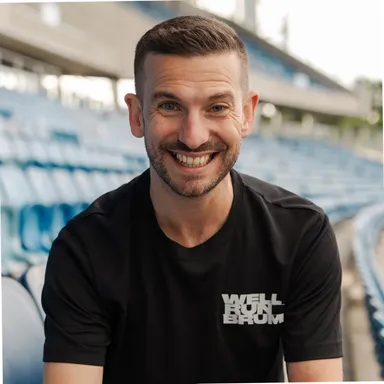
About the guest
Richard Loftus
Richard Loftus is the founder of Well Run Brum, the wellbeing running group for men and a non-executive Director at the historic Birmingham recording studios, Grosvenor Road Studios and has a career spanning two decades in the theatre and live music industry.
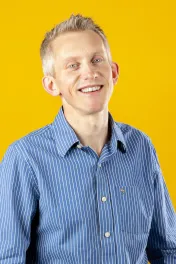
Hosted by Andrew Pain
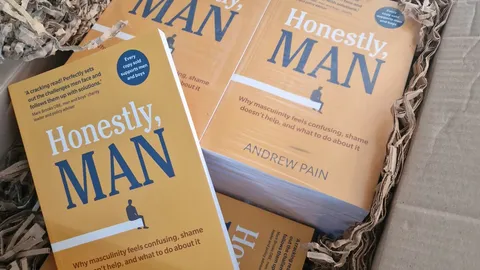
Andrew Pain is a Mental Health & Resilience Keynote Speaker who speaks from lived experience on resilience, burnout and workplace wellbeing. Host of the Men on Show podcast, author of the book Honestly, Man, and a TEDx speaker. Member, International Coaching Federation, and Mental Health First Aider trained.
Insights
Read next
Never miss an episode
Candid conversations with everyday heroes – ordinary men doing extraordinary things.