Men on Show · Episode 26
Men and the impact of childlessness with Robin Hadley
- 10 April 2024 .
- 48 min .
- Hosted by Andrew Pain .
Robin is from Old Trafford, Manchester (UK).
Andrew hosts this podcast. His own keynotes are on burnout, resilience, imposter syndrome and difficult conversations.
In this episode
About the conversation
He is a leading expert on the impact of male childlessness across the life course. In his 40s Robin switched careers and trained as a counsellor. His book ‘How is a man supposed to be a man? Male childlessness a Life Course Disrupted’ has received critical acclaim. You can find more about his work at his website:
Key points of the episode
- As always, who inspired him growing up.
- The atmosphere in the house while growing up.
- The job he did for years, then retrained.
- Statistics (and the lack of for men) on childless people.
- A possible link to male health and well being.
- Future implications for men.
- Stats for IVF.
- How these issues are not recognised in the workplace.
Men on Show shares lived experience and honest conversation – it is not medical or therapeutic advice. If you're struggling, you don't have to cope alone.
Samaritans: call 116 123 (free, 24/7) NHS: 111
Full transcript
Read the whole conversation
A complete, verbatim transcript of this episode – every word is the host's and guest's own; the topic headings are ours.
Welcome to Men on Show, the podcast, Candid Conversations with Everyday Heroes. Join Andrew Pain as he interviews fascinating guests, ordinary men doing extraordinary things. If you love the show and you think somebody could benefit from hearing it, why not tell them about it by giving it a share on social media? Oh, and at the end of the podcast, if you can leave us a five-star rating and a review, it really helps us more than you know, and it gets this important message out to more people that need to hear it the most. Right now, enjoy the next episode. The next episode.
Hi, my name's Andrew Pain, and welcome to Men on Show. And I'm absolutely delighted to have Robin Hadley as our guest today. Author, lecturer, and I think complete expert on all things to do with male involuntary childlessness. Some of his work, he was the author of How Is A Man Supposed To Be A Man? Male Childlessness, A Life Course Disrupted. He's a lecturer, and I'm so interested to get into this topic, because not an awful lot is said about this topic. And I think to learn more about that is going to be really, really cool and helpful and all that good stuff. So Robin, welcome to the show.
Thank you. And great introduction and lovely to chat with you.
Growing up in a family of eight
Oh, brilliant. So what I see to all the guests, just to kind of place this and get a sense of who you are before perhaps we get into the topic. So sort of growing up, are there any men that sort of stand out to you as really positive influences? And if so, why were they such a positive influence on you, Robin?
Okay. Well, growing up, my dad wasn't a particularly positive influence. I think mainly because I am from a very big family. There's eight of us and I'm the seventh youngest, four boys, four girls. So there's a lot of boys around me, but mainly they're a lot older than me and I think school, there's a couple of teachers that I really got on with. I think because I was born in 1960, then sort of in the teenage years, in the seventies, very mixed up decade.
But I think one of the things that was promoted was to be like Bobby Charlton, actually, as a role model of being like good at your job, being calm, not getting involved in fights and stuff like that, and being a sort of gentleman area. And when it came to early years at work, Richard Holm was a guy I worked with and he was very gentleman. Lots of stories of when he was a teenager during the war and being a trainee photographer then.
So that was really, and he was into motorbikes. That got me into motorbikes a bit. But there was a whole sort of roll around that and how to behave. And then later on in work, it was Frank Knowles who was a great photographer, a great brain and a very wise man. And if I could have been like a court of the man he was, I'd be very, very pleased, but not even that. So there were definitely men around the time.
So were you the youngest of the four boys?
Read the rest of the transcript Collapse transcript
I was the youngest of the four boys. I have a younger sister.
See, we've got three boys and they're age 10, seven and five. And they just run us ragged. And what I've noticed, cause I've got older daughters as well. And this is just from my own experience of parenting. But what I've noticed is, whereas my daughters could, they had arguments and falling out from time to time, but they could come down and sit at the table and eat a meal. The boys, they just can't leave each other alone.
They literally play fight all day. And of course it always ends in tears, every single time. So do you, your memories of being one of four boys, as well as having sisters, was there a lot of rough and tumble? Was that allowed in your family? Or did your parents sort of discourage that?
There was a lot of noise. It was quite kinetic in our family. No, we were always being told to behave. I think it was more generally, because we were quite poor. So anything that came in was fought over, but not fisticuffs fought over. And being at the younger end of the family, you tended not to get anything very much, apart from hand-me-downs. It was always from that era, really, was hand-me-downs. So I don't think we really fought, like physical fighting with each other.
I think because it was such a big family, there was like a cascade of care. So the older children were giving responsibilities for the younger one. Otherwise, that massive people in one house, there needs to be some structure there. And I think for the oldest ones, I think they felt it that they were standing parents, that they had to take a parental role. And so later on, as they've grown older, I think there's a bit of payback there.
As you now look after them.
In a sort of way, in a strange sort of way, yeah.
His father's night work, drink and poverty
Yeah, interesting. And in terms of, I mean, you mentioned poverty, and maybe that's one of them, a challenge, but do you recall any particular challenges that you think you faced growing up, and you faced them particularly because you were a guy? Is there anything that you think, yeah, this was hard for me because I was a man?
I think in our family, my brother told me this not so long ago, that the parents split the children into who was going to teach people what. And so my mother took the girls and my father took the boys, but he worked nights for, I don't know, 40 years and so we didn't see him very much. And also he was sort of forced into the authoritarian role. So mom would say, wait till your dad gets home or actually wait till your dad gets up and and then he would be the judge and jury, an executioner, executioner part.
Really? So on that one, the girls are definitely more intelligent, they've got more qualifications. But I think they had maybe it was a bonding between the women, but also more time with mom. Whereas we didn't have that much time with dad in the same sort of qualitative way.
Yeah. And I suppose, I mean, there's a generational difference here. And I don't know, your dad obviously never met him, but 40 years working on nights, what we now know that that does to the body clock, the impact on mental health. I know when I've been exhausted, the thought of spending time with my boys who have boundless energy, just want them to go to bed. I just want them to be quiet. And so that must have been a challenge for him, sort of taking on that leadership role when he's working nights for so long. That must have been tough for him.
Absolutely. And also he was in the printing industry at what was Thompson House in Manchester. It's now the print works social sort of bar place. But it was a massive printing, paper printing factory really. And the thing with that sort of press industry was high alcohol. Yeah. As a culture. Yeah. As well. And so he got kidney problems later on in life and died related to kidney failure. But he would be called obese now. I would call him a big lad, but he was tall but a heavy set would be another way of saying it.
So there's always those things. But on the course, working nights and shift work does that to your body and how you process food and store fats and stuff like that. So, yeah.
We did have a guest on this podcast, Rob Baskarin, for anyone that wants to listen. So he's now a teetotal and talks about alcohol. But my piece of useless trivia, which shows the progress we've made in understanding alcohol, this is completely useless trivia, but I love this piece particularly. So obviously today, the average, what's considered the safe limit recommended by the government of alcohol consumption for men, I think it's about 14 units, something like that. Back in 1979, what was considered the safe level of units? How many do you think it was? How many units do you think it was?
Oh, I'm going to say 35.
Expecting to be a dad, and retraining as a counsellor
Fifty-six. So you realise you've made a lot of progress on alcohol, but no, that must have been hard when you think about for your dad, the alcohol, the sleeplessness, a lot of children, poverty, those challenges must have been tough. So moving on to the whole piece around childlessness, particularly given that you've grown up in such a big family surrounded by so many siblings, that's your normality. I suppose that's your trigger, not your trigger, but your anchor for what you perhaps think family life is and what's considered normal. What was it you did your PhD at Keele on childlessness? What prompted your interest in this topic? What was it that got you into this?
Well, yeah, I'd like a lot of people. I grew up just thinking I'd become a parent. That was what was going to happen. And certainly my parents said that to me. At some point in my early teens, I wanted something. They didn't want me to have it. And you're going to have to do these hard decisions when you're a parent. Yeah. And I can see that's a familiar phrase to you. And you've probably said it as well.
It's a generational phrase that probably goes down to Neanderthal men and women, actually. Yeah. And so what happened was I worked as a scientific and technical photographer for 30 odd years and then digital photography came in and my wet skills weren't needed. And so the job was ending. And so I trained as a counsellor. I left school with very few qualifications, wasn't very good, very confident around education. So I did counselling because you could do it in nice short blocks to build it up and each block.
I thought, well, I'll fail this. I'll be found out. And I'm still waiting to be found out. But it will come definitely. Probably next few minutes. And so I did a postgraduate diploma in counselling at Manchester University and then took on the MA because counselling had to be something you experienced. And I was really broody in my 30s. I mean, terribly broody, like a big heavy cloud on me about wanting to be a dad and not becoming one.
And all my peers becoming parents sort of at the drop of a hat. I'm feeling out of sync a lot at a distance and also not knowing how to make the leap from one status to the next and feeling sort of deskilled and unskilled. And I guess unworthy. So it's a frustrating time. And so I did DMA and found out there's really nothing about men and their desire for parenthood. You know, compared to the vast amount there is around women and motherhood and the good bits and the bad bits and everything in between.
So the drivers for men to become parents, where was that? And also actually men's experience. So you can do the big stats stuff to a degree, not that there's that many. But the actual experience, people's stories, there wasn't much there. So that's what got me into it. And then I did a self-funding MSc looking at the levels of broodiness because the sort of common thought or myth is that women are broody and men aren't bothered. My argument against that is, you know, any species, let's go off planet because it's easier where you need a male and a female and either one of them is not interested in reproducing, that species is going to die out.
And that hasn't happened to the human race. In fact, we've been particularly good at taking over the world and dominating stuff. So what is there around not acknowledging men's desire for fatherhood? And why is it all around women and motherhood? I'm not saying that I'm just saying that there's an advantage to that in a patriarchal society in that everything's around women and motherhood and nurturing. And as a sort of support to that is not to focus on the men and fatherhood and the assumption that men are fertile from puberty until death, fully functional.
The biological clock and the social clock
And I wonder whether that is for me instinctively, because I know very little about this topic, and I'm so excited to have you on here and be chatting about this. But I suppose there is that view, isn't there? Well, women have this sort of quite restrictive clock that's ticking fast once they get into their 30s in terms of their reproductive abilities, the likelihood that they can conceive. And there is this view that men, well, look, you know, you can conceive into your 50s, 60s, 70s, although that isn't biologically quite correct.
Obviously, the quality of the sperm depreciates as we get older. But I suppose that's put the focus on women because it's felt that their clock is has much bigger, much tougher constraints than perhaps for men. What's for you, just before we talk about your actual research, I definitely want to talk about as a guy, what's prompted your interest in the topic is that you've seen your peers having children that they sort of sensitive and that's not happening for you.
How did that impact you as a man? You just talk about being really broody in your 30s, but not being in a position to conceive for whatever reason. How did that impact you as a man? Did you feel that that was a comment on your masculinity in some way or not really?
That's a really good question because I think it changes with time. And also with what you know, but in my 30s, I was just really aware of not being something I should be and should have a heavy lifting word there. So the ideal type and the ideal arc of life, I wasn't on that. And certainly that's reinforced by the people around you. And one of the things around reproduction, researcher in Australia, Leslie Cannell took him out, women, was the social clock was as important as the biological clock.
So what's happened with the culture you're in? You know, are your parents saying, when am I going to hear the patter of tiny feet? And then now because of longevity, grandparents are saying, you know, when am I going to be a great-grandparent? All those sort of cultural things come in as well. But for me, was it? I think on my master, I guess so. I don't think I was thinking that. I was thinking much more of how can I find someone who would want me and want to reproduce with me?
And there's certainly a lot of pressure around that at the age of 35. And that's really interesting that people focus around the mid-30s for women as being a critical point. But it's also a sort of critical point for men because that's when sperm efficacy starts to decline. And for men, there's a hormonal change as well, but it's not as severe as the hormonal change for women. So it's a much more gradual thing. But it's really interesting that if you want to be a sperm donor, then at age 40, they won't take you as a volunteer sperm donor because of those things. And that's not really well known. And some clinics, it's below 35.
It's below that. I thought it was below that. But yeah.
Yeah. It depends where you are. And if you're paying, then obviously they'll extract the best sperm they can for you. So that's the difference between the donate, the voluntary donation or even paid donation and actually paying for your own treatment. So yeah, as masculinity, it was just the difference of where I should be and what I should be. So I'm not sure if it affected my masculinity too much, although I sort of fell out of it for my class because big family working class that I was also a photographer, which is a bit strange. I wasn't on the tools or doing sort of traditional working class or aspirin working class. It's a bit of a strange thing. So yeah.
The silence around childless men
Yeah, and it's a horrible thing feeling like you are on the outside in some way, that you don't have these connections, whether your job puts you on the outside, whether it's a family, these milestones that you don't feel you've ticked that others have. Because when you're on the outside, I know when I felt on the outside, your brain starts creating all these stories about what people really think about you. And it can be hard to keep a really firm grip on perspective.
Just in terms of your PhD, what would you say the key findings were? That piece of work you did, what are the headline things that you would say you found from doing your PhD on childlessness?
For men, it's the silence around it. There's lack of narrative for men to occupy. Compared to women, when there's lots of narratives, and some of them aren't really good, some are very negative, some are positive. But you can weave a story around it. For men, it's that lack that is really significant. Because all the men I've spoken to have said, there's something missing. And that's a really important little phrase, something missing. Because there is, there's something missing inside, so the ideal way of being, fitting in.
But there also is something missing in the social narrative, that you can then build your identity around. So if you're chosen childless, there tends to be narratives around that. Again, more for women than for men, but some for men, they tend to be a bit binary. But for circumstantial childless, or involuntary childless, we've got to just acknowledge anything to do with childlessness. The phrases you use, different people use different ones at different times. So try to be inclusive, but we're not on a conference somewhere nice to discuss that for a week.
So just acknowledging that. Yeah. So on my PhD, that childlessness doesn't go away. The roots to childlessness are varied. And economics is an absolutely key one. That's not often acknowledged. Class, the choice of partner, relationship type and what happens in a relationship. All those are, apart from class, are variables that change with time and with what's happening at a specific point. But there's something missing, there's a sadness there. And a difference. And one of the consequences of that, but actually came through for other men as well, as you get older, this fear of being seen a paedophile increases. Really?
That's so interesting.
Absolutely.
I'd never ever have guessed that. But now you say it, you can see, it's a single male living on the street or in a block of flats, wherever. Yeah. So I'm stunned because that's, I just hadn't ever thought, but it makes complete sense.
Actually, some fathers feel that as well.
Yeah.
When there's a pyjama party or something like that, they're very aware of being a male in the house with girls, mainly but young children, and then position themselves to be safe. One of my colleagues a few years ago said, you know, my dad was coming around for Sunday lunch, and he was a bit late. And I said to him, you know, where you've been? He said, I was playing football with some kids in the park as I walked through. I said, well, you can't do that. You'll be seen as a Peter fan.
And some of that is not just sort of absurd paranoia on the part of men. Charlie Bethel, that's again one of my podcast guests and a former podcast. When they went to set up a shed, he didn't say where geographically, one of their sites that they wanted to set up a shed was opposite a school, and there were other charities operating within that site, and they refused permission because they were seen as a safeguarding risk simply because they're men. I suppose if you're a single man, perhaps that suspicion is higher, and that's awful when you really think about it.
It is. When I was in a conference in Borneo a couple of months ago, I gave my talk and I mentioned this, and the panel said, what's all this about? So it could well be a Western thing. They were shocked by that. So there's definitely a social cultural thing in there.
In terms of what's this all about, the Borneo, in reference to the...
Older paedophilia and older men.
Older men, yeah, yeah. Just wanted to clarify that.
That the culture around family and inclusiveness of older people back into the family as they grow older is sort of highlighted there, I think.
How many men are childless
And I suppose as well, so the whole thing, intersectionality is one of these sort of modern words. It's where you have a subgroup within a subgroup, and you realise actually within any group of people, there's then lots of different groups that face different challenges. But in my mind, when I think about involuntary childless males, there could be fertility issues. It could be that they struggle to find, they're just not in relationships at all. They're not successful in navigating that world.
It could be that they're in lots of relationships, but never one that's serious enough to consider children, although ideally they'd like children. It could be that they want children, but they settle down with a female partner who didn't want children. Maybe she already had children. Maybe she doesn't want children. So within each of these subgroups of involuntary childless males, when you really think about it, there are different challenges, different things they're going to face. And some of it, I think, is just being aware of it and seeing more of this research.
Well, therefore, how does that impact them later in life? How does that impact their mental well-being? We need to do more on this. Do you know what percentage of men are childless over a certain age? Have we got any percentages on that?
In Europe, I think there was a study. The big stats problem here is that when a child's birth is registered, the mother's fertility history is taken. So fantastic data going back decades on that level. So it's easy to work out the level of childlessness because you know how many women there are, you know how many have had children, therefore you know how many haven't had children quite easily. And so it's run about 20%, just under 20% in the UK.
Is this men?
Women.
Of women, right, yeah.
For men, it's about 25%. But the problem is, it's like one-off studies here, there and everywhere, you get that data from. Because that data at birth registration for men's fertility history isn't taken. So it's not regularly updated. So it tends to be one-off studies here, there and everywhere. And that goes for most of the world apart from Scandinavia, where they do record men's fertility history as well. And again, but it's about the same percentage, 20% women, 25% men now.
That's changed over the past 50 years. I think back in 1960, it was about 10% of women didn't become mothers. From the late, from the 70s onwards, that's increased the level of childlessness, of women's childlessness. Men's, we don't know because we haven't really got the data, apart from these odd studies. And also the age of first birth has risen as well. So something like early 20s in the 60s, average age of first birth, to now just knocking over the age of 30 for the UK.
And I think for a lot of Western countries as well. And if the women's age of first birth is, let's say 31, then the average age of first birth for a father is probably going to be 33 or 34, because it tends to be a couple of years difference in age.
Childlessness, health and growing older
But if we assume, and you've done some research, so we're not actually assuming, if we can say involuntary male childlessness has an impact on that man, on perhaps his future predictors and all of that for sort of mental well-being, et cetera, then 25% is a lot of men, actually. That's a huge group of the population. And you've thought, well, therefore, we definitely need to do more on this as a topic research-wise.
Yeah, well, the thing would be to recognise childlessness as a category, and it's not recognised as a category in a social or data-gathering thing, as just a regular collector, you know, gender, age. Are you a parent? Yes, no. Are you a biological parent? Yes, no, would be the thing. And that would just be a simple thing. And then that just feeds into all the data. And helps actually say, well, is that a factor in health? And again, sort of one-off studies here and there around the world.
So there's a big study in Sweden about 20 years ago looking at fathers, non-contact fathers and childless men, age between late 20s to early 40s. And they could do that because when in Sweden you're born, you're given like an NI number, but it covers everything. It goes across everything. It's not siloed like it is here. So it's very easy for them to gather all the data for health, for death and all that sort of thing. And non-contact fathers and childless men were more at risk from suicide, ill health through risky behaviours, drinking, smoking, drugs, accidents.
You know, Sweden, it's hunting, shooting sort of place. So all those sort of things were a factor in there. When it comes to suicides in this country, again, because we don't do that basic data gathering at child registration, it's difficult. But there was a study done in 2021, and they found that 32% of male suicides between, I think, 30 and 60 age were parents, sort of indicating maybe 60 odd percent weren't parents. Got to be a bit careful because we don't know if they're childless or whatever.
But it's sort of indicative that could be it. And if we're thinking about men and the stereotypes around men, they're sort of validated by things outside their bodies. What you do for your work, are you good at sports? Are you popular? And what we do know about suicide for men is when those things aren't there, they've lost their job, they've split up in their relationship, and there's a cumulative effect. That definitely impacts on that. Again, we know that men and women seek help at the same sort of level, but men drop out after a couple of attempts at trying to get help, and then tend to, not tend to, but it's a factor on the pathway to suicide.
So what's happening there in the services around that? And there was a study about health in mid-aged people, and again, childless men, it was a factor that they had poorer health than parents and than childless women, but there was no effect of being childless on their health.
Yeah, yeah. And I can see that. Again, just sort of reflecting on my own thoughts. I mean, if I have a day with the children, I used to wear one of these fits bits things that measure your steps. I don't know how accurate they are really. And the government, you know, I see guidelines moving from 10K steps to 5K steps every day, and it changes. If I've got a day with the kids, it's like a Saturday, it wouldn't be possible for me to do less than 15,000 steps.
I couldn't do it. I couldn't do any less, because I'm on my feet with them. It's relentless. Whereas if they're away, like my wife's taking away actually for a couple of days this weekend, I've got a cheeky break. I just can't wait. But then what happens in two days? I'm like, I want them to come home now because I don't know what to do with myself. But on those days, those will be the days where the Fitbit, yeah, I'll be at 3,000, 2,000 steps.
The kids have me on my feet the entire time. And there is that inspiration. I play football to really keep myself fit and well, because I want to do stuff with them when they get older. But if you took them out the equation, well, just on a day-to-day basis, my step counter would drop massively. My activity levels would drop. So you can see how a lot of these things are so linked. They give me so much purpose and structure around my day that I just wouldn't have otherwise.
I'd faff about so much more. I can't faff about because my time is so limited, thanks to my children. But without them, I'd have so much time on my hands that I'd faff a lot. I'd then be annoyed. And all of these habits. So I can see how a lot of these things feed in. And I was going to ask you actually, and I'm going to have to look up at my notes above my camera here.
Morphia is M-A-W-F-I-A, men ageing without family, isolated and alienated. And so I was going to ask if there is research linking morphia to higher rates of Alzheimer's, suicide. But from what you said, we need to do more research on this. There's some indicative research, but not a whole lot of research.
Absolutely. And because childlessness isn't a category, it's not collected. And that's really, really difficult. So it's really difficult to get it off the ground. So like I say, you go around all different bits where somebody has happened to do it or looked at it specifically. And that's great. But after a few years, people say, well, that's five years old. It's not representative of the whole population. And it's hard to generate then cash for research. So I was at a meeting.
I was a founding member of a group called Ageing Without Children. That's still going. And we had a meeting, a parliament with a Lords committee, and there was a high up person from the NHS. So we put in this, and she went, Luke, why should I change policy on this? You've not given me any data for any cash savings for me to introduce that. And we're like, there's like three of us and a pencil. We don't have the resources.
You're in charge of a big section of the NHS. Pick up a phone, get somebody in and say, Luke, you know, this could be a thing. Can we find out about it? But the thing was a block straight away. And also the block was around cash. You've got to prove there's going to be a cash savings. Well, actually, the ONS did a couple of reports in early 2000 looking at projections and said that in 2045, there's going to be a 30% increase in the level of childless women aged 85 and over.
And this was a concern for health and care provision. Nothing on men, apart from acknowledgement, there's not much data on men, but we don't think it's going to be a bit of a problem. Well, you just said you've got no data on them, so how do you know it's not going to be a problem? But from the data I've just said, there's probably more childless men and also more childless men as you grow older. As families split up, the men tend not to be involved, tend to get separated off, so you can be a childless man who's a parent, but you're effectively childless because you're not in contact.
Yeah, yeah. So in 2045, there's going to be a cohort of men knocking on the door of the social health and care services, and they'll say, well, we haven't got capacity for you, because way back in the 2020s, they didn't recognise this as a population that's going to affect us.
Childlessness at work, and IVF
Yeah. So in a way, you've answered...
Sorry, I've gone and put it on a big...
No, no, no. You've actually... I think you've probably just answered the final question I was going to ask on childlessness just before we pivot towards the end of this podcast. I was going to ask you how we best support this group of men. Is there anything... In fact, I've got it written down. Is there anything the government should be doing, talking about? I'm presuming you're going to say, well, recognising the group would be a very good start, so we can actually do some research. But is there anything else we can do on top of that?
Doing this, I just recognise it. I think, like, for work, there's lots of stuff around parenthood, particularly motherhood. Becoming pregnant, lots of things kick in. I know there's paternity leave, but it's very much reduced compared to the rights around women.
Two weeks.
And then there's the social element around that. Can I afford to take that off? How will that look? Often that depends on your line manager. If you're going through IVF, then the thing about IVF is it's not very successful. It's only about a 20% success rate. Sorry, I should have put a trigger warning there. If you're going through IVF, ART, a bit of a trigger warning. And it's very, very stressful, even successful. IVF is really, really stressful.
There's a lot of it focused on women and the men as well. And when it fails, depression, arguments, all that sort of thing, there's a lot of stresses in there. But when it comes to the workplace, it's not really recognised because you're not pregnant. You're in that sort of zone of not being a parent or not being pregnant. And you can't really go to your boss and say, well, we're trying. Yeah. It'd be very difficult. And they'll probably say, well, we've got no policy for that.
Let us know when it's successful. But with IVF, there's usually, not usually, there's definitely a chance of miscarriage with IVF and baby loss. And that then, and it can happen multiple times, is a problem at work because it's not recognised. And certainly in one project I was involved in at MMU just a couple of years ago, one of the women said, you know, my line woman, my line manager said to me, but you've already had your bereavement leave for this year.
So really, you can't have any more, you should be in or you've got to take it off. So, but for men in work, what do we say about men? And their desire to become a father? And how do we deal with that? How do men deal with other men? A couple of years ago, a couple of guys I used to work with, they're now profs, they were in their early 40s, so they didn't really well in their career.
And they wrote to me separately and said, you know, I've done really well in my career, I've got a good post, good job, married, but I didn't know what I was missing until I became a dad. And again, that key word, I didn't know what I was missing. And that just says so much to me about what is missing out there and missing for men, that actually it's all in there, we have a feeling for it, but I have almost no official or appropriate outlet until it actually happens. That expression of feeling and desire, that's taken away from us at a very early age.
Men, boys and role models
Yeah, yeah, interesting. So moving slightly more broadly, just in the last few minutes we have together, we know that men and boys are struggling in lots of areas. You only need to look at data around suicide, rough sleepers, prison population, education, mental health. Do you think men and boys are struggling? And if so, what do you think is at the heart of that?
What's at the heart of that? I think they are. I really do think it goes back to an early age of, if you look on Facebook, when a young boy is referred to as my little soldier, my little man, and sometimes the babies when it's like that, what is that saying about what else is coming through loaded around there? That's the sort of detachment. His man is three years old. It's not a man. If you, a similar aged girl, my little princess, not my little woman.
Yeah, you see princess all the time, moms and dads.
And older women would then say, yeah, you know, and I run an international firm with thousands of people, and I'm still my dad's princess, would be their thing. But that just shows something about how this thing about men almost get a concrete block put here as boys to say, okay, all that emotional stuff stays there. And it goes out through actions. So it feeds into that stereotype of men being judged by things outside themselves. Yeah.
And it's interesting. I mean, even I think the media has got a lot to catch up with. You know, if you look at famous TV characters with jobs, Fireman Sam, Bob the Builder, Postman Pat, you don't have Mike the midwife. You don't have Penelope the pilot. If you look at Pizza Rabbit, the BBC series of Pizza Rabbit for children, lots of episodes about 20 minutes long, but look at the characters. Peter Rabbit never backs down, never gives up, adventurer, you know, always got a plan.
There's no emotional outlet that he's scared. He's never scared. The female characters have their pretty dresses and their little baskets. They go with the piece. Old Brown the Owl, Tommy Brock the Badger, Mr. Todd the Fox. They're all male. Mr. McGregor, male. They're all the baddies, so the males are the bad. So I think there's a lot of character, sort of stereotypes within children's TV which don't help us. I think the media TV have got a lot of catching up to do, I think, to fully create.
I'm trying to think of my words here carefully. But to catch up with what's possible for men, women, people, to celebrate the fact that men are also emotional creatures, we get scared. It's not a bad thing to get scared. To put that across in some of their messaging, to encourage boys as well as girls to be actually expressing how they feel, actually, I'm scared and it's okay to feel that. I don't feel there's a lot of that. I feel like there's more work to be done there.
I think also, I'm just thinking back when you said about boys to then, me in the 70s, and role model being Bobby Charlton, there was no computers, no social media, and three channels on the TV. If you had a TV, it was a lot different. And ways of being were limited. As a working class, I was going to get a job. I was going to find a girl, get married, and have a family. And that was my life arc.
But now, for I think younger men, lots of people trying to sell you stuff. And they're trying to sell you stuff, and what they sell is the ideal. You never sell the burger, you sell the sizzle. So, and you look at the adversity, I don't know, for cars. These cars magically appear. The people who are in them don't seem to have jobs, they just seem to be rocking around having a good life. It's not based on reality.
But those adverts are very carefully crafted, and very targeted. And I think there's something around the targeting of young people, and what that is about, that's harmful, because you're putting up lots of little ideals. And the thing about ideals is they're hardly ever achievable. And once you get there, there's another one, or it's not the ideal you thought it was.
That's so true. If you see like a BMW, for example, or a Jag, a brand new advert, a car, and it's an advert, the person driving it is always going to be good looking, and suave, and so on. They're not going to be overweight with a string vest on, are they? It's not going to be full of clutter and junk, because the kids have been sick in the back, and there's crisp packets in it. It's just this idea of perfection that isn't real.
Absolutely, and there'll be an attractive other.
Yeah, always.
Always an attractive other. Yeah.
Yeah.
Magically.
So, how do we help men and boys, if there's one thing that we could do for men and boys, to try and address some of these awful stats, to create a more rounded, better emotional wellbeing for men, what's one thing we could easily do?
I think recognise false gods. If we could do that.
I like that. Recognise false gods. I like that.
I think that would help a lot. And actually, you're human. And we're variable, messy things. And that we change over time. I think that's something I drive of being always the rock, the stable thing. And you're going to be like that all through life, which is lovely. But the environment around you is so variable. Better to be a bendy tree than a rock.
Brilliant. Normally, I ask guests for a final one sentence to inspire us. But I think you've just said it. Better to be a bendy tree than a rock, because we have this very variable environment. Anything can happen. Often we have false expectations that aren't met. So we need to be able to flex with what is real.
Yeah.
Amazing. Robin, it's been an absolute pleasure having you on the show. How can people find out about your work or connect with you? Where can they go?
They can go to robinhadley.co.uk, my website. Just Google me and I should rock up in all my beauty.
In all your beauty. And just so that we know, Robin is robinhadley.co.uk.
I-N, yes.
And Hadley, H-A-D-L-E-Y.
E-Y, yeah.
Perfect. Robin, it's been a pleasure having you on the show. Thank you so much for your time.
Thank you for giving me the opportunity. I really enjoyed it.
Thank you for listening to Andrew Pain's Men on Show. If you could leave us a five star rating and short review, it would be really, really appreciated. It helps us get this important message out to more people that need to hear it the most. See you on the next episode. Thank you for tuning in.
About the guest
Robin Hadley
Robin is from Old Trafford, Manchester (UK). He comes from a large working-class family and left school with few qualifications. His careers include research consultant, counsellor, deputy technical manager, scientific photographer and kitchen assistant. Robin’s training as a counsellor and his own experience of desperately wanting to be a dad led him to research the desire for fatherhood in childless men as part of his MA in Counselling (The University of Manchester, 2008). He then self-funded MSc in Research Methods (UoMr, 2009) exploring the levels of desire for parenthood (‘broodiness’) in females and males, parents and non-parents.
Robin then successfully completed his PhD at Keele University (2015) where he examined the impact of involuntary childlessness on the lives of older men. His research has been widely published in international and national media. He supports several infertility and involuntary childless support groups and is a founder member of the campaign group Ageing Without Children.

Hosted by Andrew Pain
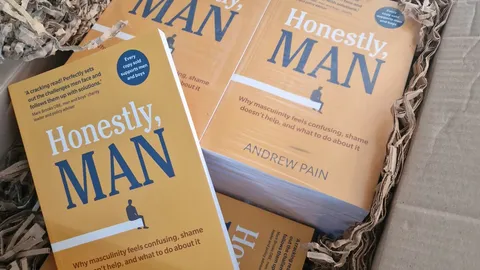
Andrew Pain is a Mental Health & Resilience Keynote Speaker who speaks from lived experience on resilience, burnout and workplace wellbeing. Host of the Men on Show podcast, author of the book Honestly, Man, and a TEDx speaker. Member, International Coaching Federation, and Mental Health First Aider trained.

Never miss an episode
Candid conversations with everyday heroes – ordinary men doing extraordinary things.