The burnout risk hidden inside every change programme
You probably recognise this curve below. It’s the Kubler Ross Change Curve, invented in 1969 by Dr Elisabeth Kubler-Ross, who introduced the 5 stages of grief in her book On Death and Dying. The model was adapted to describe the emotional stages a person travels through when experiencing organisational change. And of course with models and frameworks, so long as we treat them as conversation starters rather than gospel truth, they can be helpful.
The change curve still has a value today in that when people experience change, there is a journey they experience, whether that is a work-based change or home-based change. But when you think about how you experience change, what do you make of the curve?
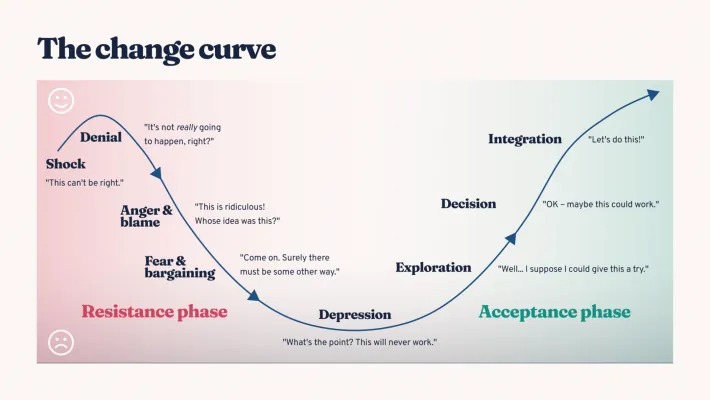 Kubler Ross Change Curve
- If we look a bit closer, is this curve too good to be true?
- Can the change journey really be conveyed in a neat curve - and in such predictable stages?
- And if you’ve arrived at the ‘depressed’ stage, maybe it’s good news because you’re half way along the curve and the only way is up? Soon, you’ll be ‘exploring’, then ‘deciding’ and finally ‘integration’ - how wonderful - lets crack open the Prosecco.
My experiences of change have not followed a neat curve.
The house move I chose to make, but months later, I’m still unsettled in my new location. The loss of my business in the 2008 banking crisis and with it, all form of income gone and my financial plans (short and long term) in ruins. Even several years later in 2010, I was still struggling to move forward. When I experience change, whether I choose it or not, my journey looks like this:
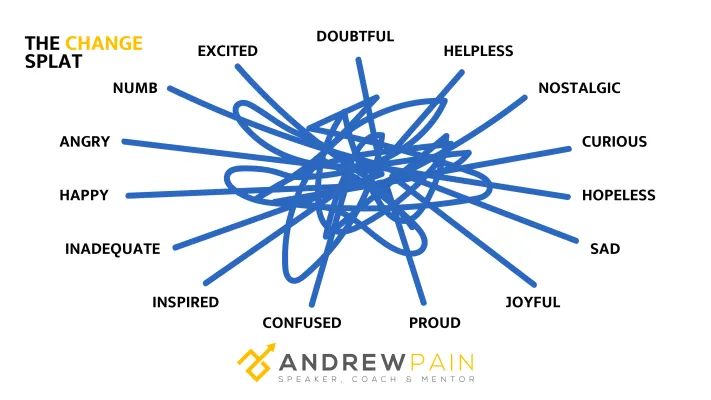 Andrew’s Change Splat
I could experience all these emotions, many times on the same day and within the same few minutes, and as for that curve, I could be in the ‘deciding’ and ‘integrating’ phases, but then have a bad day, so I’m flung back into the emotional chaos of the change splat.
Change is messy and unpredictable - a splat NOT neat and curvy
And this is where burnout and change can go hand-in-hand. If you want to manage change and reduce the risk of burnout …
-
Do not assume that just because the change happened a while ago and most people ‘seem’ ok with it today, that they are actually are ok with it today.
-
Do not assume that people experience the same change journey. They won’t. Their traits and habits may affect how they deal with it. Some people are more open to change because they don’t live their lives as creatures of habit - others struggle more. Some people struggle today with change because they’re overloaded and under-pressure - in easier times, they would probably have been ok with the change. Others are trying to be ok with change because they know they should, but they’re struggling and feel unable to say so.
-
Emotional turmoil is a known trigger for burnout, as is constant change, and if someone burns out, they could be off work for months, so stop seeing change as a neat curve which most people will follow. It’s an unpredictable mess, which means as leaders and managers, we must keep talking and be compassionately patient with people.
If your team are struggling, don’t brush it off!
You may feel they’ve had long enough to deal with the change so they should be over it, but there is no set timescale for dealing with change. The is no neat curve.
Change is a messy splat - not a neat curve - there is no ‘stage’ where the risk of burnout disappears
If you want to bring the topic of burnout to life, either as a keynote talk, or as part of an away day, or wellbeing week initiative, or even as a collaborative, mini-podcast series for your organisation, then get in touch and let’s talk.
I’m a CPD accredited and TEDx speaker, podcaster and author, delivering entertaining, inspirational and relatable keynote talks, grounded in lived experience and global research.
Connect with me at: https://www.andrewpain.co.uk/
And/ Or let’s connect on Linkedin and DM me to book an exploratory conversation
A version of this article was first shared with Andrew's newsletter subscribers on LinkedIn .
Get the next one straight to your inbox
Andrew writes regularly on men's mental health, burnout and resilience. No spam, unsubscribe any time.
Subscriptions open shortly – the mailing list isn't connected yet.
Booking a speaker instead? Let's talk .